

THE PROBLEM
Agricultural data collection is failing on three fronts
The conventional model for collecting field-level agricultural data was built for a regulatory environment that no longer exists.
The cost structure is
unsustainable

Conventional data collection is costly, but massive budgets rarely reach the farmers who generate the data. Instead, funding is eaten up by operational overhead, transport, and enumerators or auditors.
Farmers carry the
burden without sharing
in the benefits

Smallholder farmers participate in repeat, redundant interviews across compliance programs, certification audits, and impact evaluations, often without receiving documentation, compensation, or actionable feedback. This pattern produces survey fatigue, which further degrades data quality, and it concentrates value upstream from the farm.

Existing methods can't
deliver verifiable data at
the resolution buyers require

Remote methods lose visibility in the crop systems where verification matters most, and enumerator visits depend on self-reported figures that are rarely cross-validated.
The European Union Deforestation Regulation, proposed due-diligence legislation in the United States and the United Kingdom, and tightening private-sector buyer standards are compounding demand for verified field-level data, and the existing methods cannot meet the demand at scale.

OUR SOLUTION: HOW SUPQUA WORKS
Verification is embedded in the workflow, not a one-time audit
Supqua organizes data collection into a four-step workflow, with each step producing evidence that the next step can validate.

01
Inputs

Farmers use a guided method to capture geolocated evidence from their fields. The application is designed for ordinary smartphones and works in low-connectivity environments.
02
Activities

Our system verifies the submitted data through a patent-pending combination of automated and human review, built specifically for the conditions of smallholder agriculture.
03
Outputs

Each verified farmer-report delivers EUDR-ready evidence and farm-level insights. Farmers and agri-small and medium enterprises (agri-SMEs) receive their own dashboards, supported by an embedded AI advisor.
04
Outcomes

The system is designed to deliver verified data at a fraction of the cost and field time of conventional methods. Direct compensation to farmers is a core design objective, to be operationalized during the pilot. Farmers can act on their own data through dashboards and an embedded AI advisor.
Built for the reality of smallholder farming, our platform delivers critical data at a fraction of the cost of traditional methods.
The patent-pending method behind the workflow
Data collection with an embedded advisor
We use a patent-pending workflow that turns reliable field-level data, gathered in low-resource environments, into evidence that meets modern audit standards. Verification is proprietary and embedded throughout the process.
The transition from a project-based manual collection to a continuous digital stream creates a transparent ecosystem where data value is shared fairly with the farmers on the ground. Farmers get access to their data coupled with dashboards and an embedded AI advisor that helps them improve farm management.
GEOGRAPHY & DELIVERABLES
Starting in Colombia, with a path to expand
Our initial deployment focuses on smallholder coffee systems in Colombia, where the founder has deep professional networks and where the need for verified field-level data is immediate. Expansion to additional geographies and crops is planned as the platform matures.
COLOMBIA · expansion to other shaded-crop geographies in development
What each verified farmer-report contains
What farmers and agri-SMEs receive directly
-
A geolocated boundary polygon supports EUDR compliance and buyer due-diligence requirements.
-
Each report packages the evidence that buyers, certifiers, and regulators require, in a format that survives audit.
-
A dashboard turns the submitted data into a planning asset that supports decisions at the farm and the enterprise level.
-
An embedded AI advisor delivers tailored agricultural guidance in plain language. Direct compensation to farmers is a design feature to be operationalized during the pilot.
WHO WE SERVE
Three audiences, one verified evidence layer
Supqua sells data as a service to the institutions that need verified field-level evidence, while compensating the farmers who generate that evidence. Each audience receives a different cut of the same underlying record, priced and packaged for the work they need it to do.
For buyers, certifiers, and
impact investors

You receive EUDR-ready polygons and field information at the scale your due diligence pipeline requires, with evidence trails that survive audit. We offer flexible commercial arrangements scaled to your pipeline.
For agricultural
cooperatives and SMEs

You can partner with us to lower your per-farmer cost of compliance while reducing redundant data collection demands on your members.
For smallholder farmers

You retain a portable record of your land, your production, and you receive compensation tied to your data. The data is yours to authorize: you control who sees it, and you carry it across buyers, programs, and certifiers.
ABOUT
Built because the people who generate data deserve to benefit from it
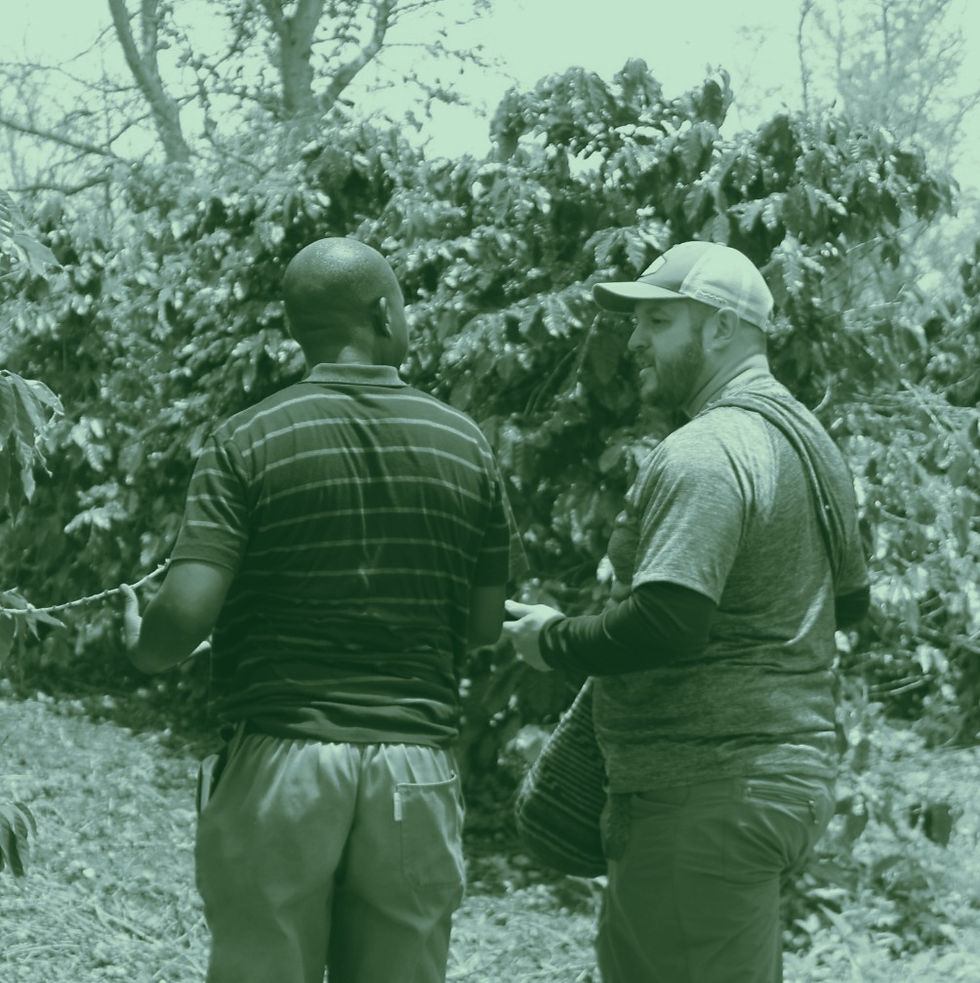
Supqua was founded by Juan C. Taborda Burgos, Ph.D., to address a pattern he encountered across 15 years of agricultural development work. Smallholder farmers participate in extensive data collection cycles for buyers, certifiers, and impact evaluators, often without receiving documentation, compensation, or actionable feedback in return. His career building monitoring systems across Latin America, Africa, and Asia gave him direct visibility into both sides of the failure: why current methods extract value from farmers, and why those same methods fail to deliver the verified data that buyers and investors require.
Juan's technical work centers on the methods that make Supqua possible. He has built monitoring and evaluation systems for governments and NGOs in low- and middle-income countries. His broader stack includes impact evaluation methods, drone-based collection, satellite remote sensing, geospatial analysis, and statistical validation methods that flag inconsistencies in self-reported data in real time. In his previous role as Director of Impact Monitoring, Evaluation, and Learning at an international agricultural impact lender, he led a team that oversaw M&E data systems for more than 570 agricultural clients across 13 countries, supporting $177 million in loans and capacity-building services.
Juan holds a Ph.D. in Development Economics and International Political Economy from The Fletcher School at Tufts University, a Master of Public Policy from the Hertie School, and degrees in Political Science and Public Law from Universidad de Los Andes in Colombia. He is a Fulbright and Colfuturo alumnus, and an inventor on a US provisional patent (pat. pend.) covering the guided-sampling and validation system that underpins Supqua.
What drives Juan to build Supqua is the conviction that technology can shift power in agricultural supply chains rather than simply making existing extractive practices more efficient. His experience has taught him that sustainable solutions must create value for farmers first while meeting the legitimate needs of buyers, investors, and regulators for verified data. Supqua represents his commitment to building a scalable enterprise that makes farmers both data providers and data beneficiaries.
Technology must be built both with and for farmers, placing their experience and needs at the center while still meeting the legitimate demands of buyers, investors, and regulators for verified data.
TECHNICAL CO-FOUNDER
Juan is joined by a technical co-founder whose role at Supqua is being formalized. Their identity will be publicly disclosed at a later stage.
They bring more than 10 years of applied experience in machine learning and data science, including the computer vision systems that underpin our methodology. Their full bio is available to verified investors and partners on request.
For verified investors and potential partners, the full bio, name, and a brief introduction call can be arranged on request. Inquiries should go to info@supqua.org with the subject line "Inquiry about Supqua technical co-founder."
CONTACT
Currently raising seed and
signing pilots
Supqua is engaging with donors and seed-stage investors and with agriSMEs, cooperatives, certifiers, and buyers interested in pilot deployments. Use the form below to request a briefing, a one-pager, or a partnership conversation.
© 2026 Supqua LLC.
Photography by Juan Taborda and Whitney Mutale

© 2026 Supqua LLC. All rights reserved. · info@supqua.org